The problem with disconnected TPA billing
TPA pain in Indian hospitals is rarely a single missing software feature—it is accumulated mismatch. Pharmacy dispenses against one record, billing edits another, finance prepares a portal row from a spreadsheet, and returns happen after discharge without updating the payer narrative. Pre-auth context lives in email while the counter bill shows cash. Branch B's hospital pharmacy uses informal workarounds branch A already banned. Month-end becomes detective work: which bill, which batch, which return, which document never attached. Standalone TPA modules or accounting exports cannot fix context that was never captured at the counter. Teams then chase rejections that began as operational gaps, not payer malice. The cost shows up as delayed settlement, write-offs, and pharmacy–finance friction—not only as software license fees.
Traditional workflow: portals, spreadsheets, and siloed pharmacy POS
Traditional hospital TPA operations stitch together a cashless portal, a pharmacy POS, ward billing shortcuts, and finance trackers. Admission or reception notes payer category informally. Pharmacy dispenses with partial awareness of pre-auth limits. Billing staff re-key items into a register that was not designed for TPA document trails. Finance exports totals into Excel to match payer aging, then argues with pharmacy about returns after discharge. Multi-branch groups lack consistent branch and user context on each event. Offline ward sales may never sync payer flags correctly. AI and queue tools—if they exist—do not connect to the bill finance submits. Each team maintains a partial truth; reconciliation meetings reconstruct the patient journey from memory. Software vendors promise automation while hospitals still manually prove what was dispensed, billed, and owed.
Hayati workflow: TPA alignment on the Healthcare Operating System spine
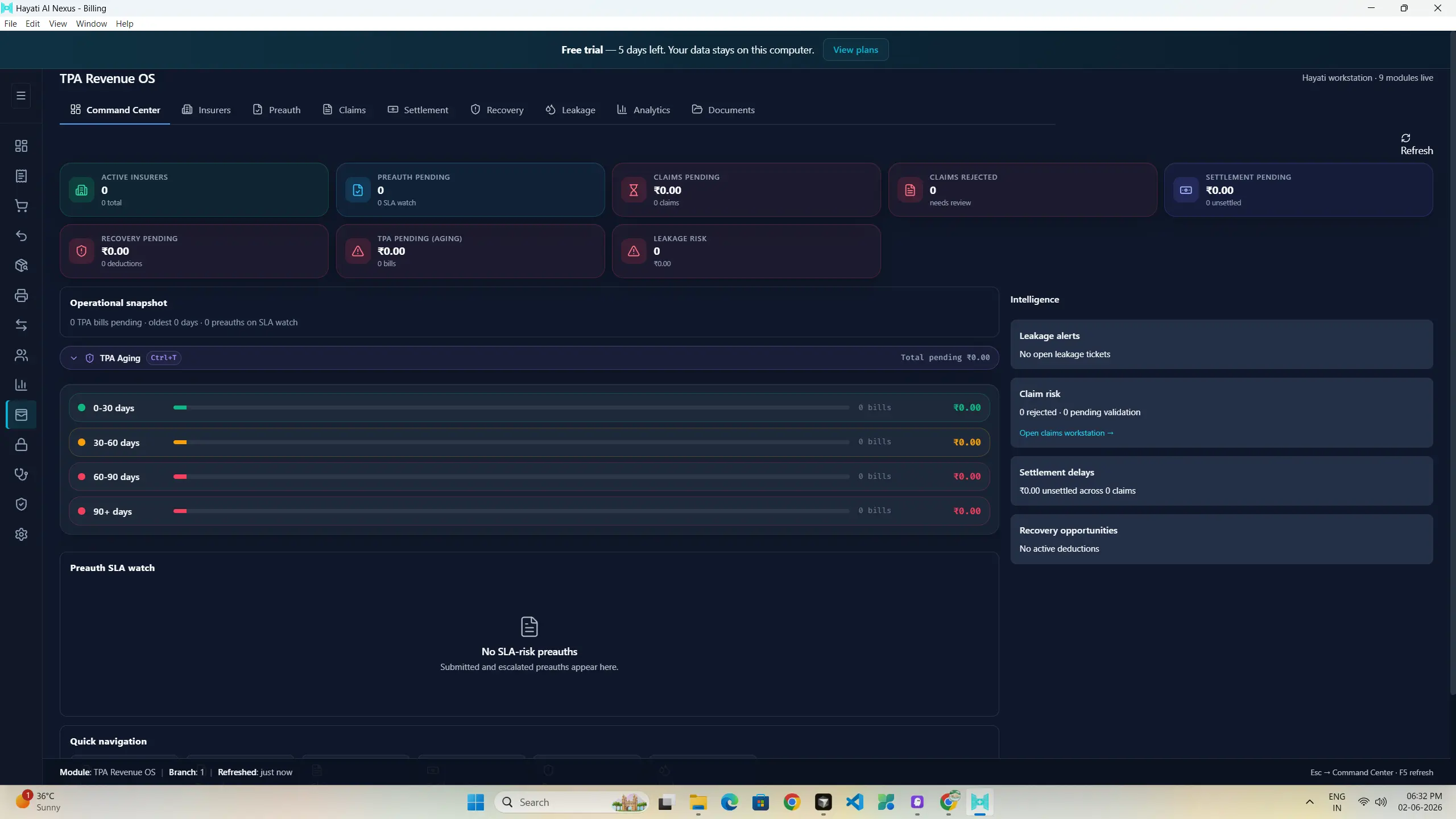
Hayati keeps TPA alignment on the same Healthcare Operating System spine as GST billing, inventory, queue, and consult—not a bolt-on claims product. Patient and payer context starts at governed AI reception or reception check-in and persists through queue and Doctor Dashboard when enabled. Pharmacy dispense produces a GST-shaped bill with batch movement and payer category on one operational event. Finance reviews branch-scoped exception queues and aging views tied to bills staff still recognize—not abstract ledger rows divorced from the counter. Returns and corrections trace to original bill and stock context where policy allows. Offline-first counters record payer-linked sales locally and replay with branch context when connectivity returns. Portal submission, document formats, and payer contracts remain your procedure; Hayati reduces internal chaos before that handoff. Scope MediAssist, Paramount, Star Health, CGHS, or your actual mix honestly on walkthrough—no universal automation claims on marketing pages.
Benefits for hospitals, clinics, and pharmacies
Hospital pharmacies gain bills that finance can explain without a second interview at the counter. Finance sees exceptions earlier—missing references, return-after-bill patterns, branch inconsistencies—while documents may still be accessible. Operations leaders compare branches without flattening every facility into one useless total. Retail pharmacy arms of hospital groups apply the same inventory and GST discipline as OPD dispensaries. Clinics with cashless tie-ins start from visit context instead of re-typing patient details at dispense. Benefits are operational: fewer internal rejections born from mismatch, faster review cycles, clearer accountability between pharmacy, billing, and accounts. Hayati does not guarantee payer acceptance or automate every portal rule. It gives teams a cleaner hospital-side record and disciplined handoffs—especially valuable when TPA mix spans corporate, PSU, and state schemes with different document expectations.
AI integration on the TPA workflow
AI modules on Hayati support intake and continuity—not autonomous claims submission. AI Receptionist can capture payer hints, appointment type, and callback numbers on after-hours calls so reception validates cashless eligibility before dispense. Queue management prevents wrong-patient handoffs that become TPA document nightmares. Doctor Dashboard links orders and prescriptions to billable context so pharmacy is not guessing what was authorized. AI Retention Agent may schedule follow-ups that produce new billable visits under governed scripts—never altering settled bills silently. AI does not read payer portals, approve pre-auth, or replace insurer policy. It reduces missed intake and ambiguous patient identity that downstream become TPA mismatches. Hospitals should measure escalation rate and correction time in pilot branches—not marketing ROI percentages we do not publish.
Connected modules on one Healthcare Operating System
TPA alignment consumes context from every major module on Hayati AI Nexus: AI Receptionist for inbound calls and booking handoff; queue management and Patient Queue Display for OPD order; Doctor Dashboard for consult and order context; GST billing for register-shaped evidence; pharmacy inventory for batch-level dispense truth; offline billing for ward and Tier-2 counters when links drop; multi-branch governance for facility-scoped aging and sync. Product and platform pages describe architecture; this page describes payer-linked workflow on that spine. A serious evaluation follows one cashless case from intake through dispense, internal review, and portal handoff—with anonymized real examples, not generic slides.
Comparison: standalone TPA tools vs Healthcare OS workflow
Standalone reconciliation spreadsheets or payer plugins focus on finance rows after the fact. Hayati focuses on capturing payer context at operational events—dispense, return, branch, user—before finance builds portal submissions. Generic accounting software rarely owns pharmacy batch movement or OPD queue order. Cloud HMS suites may weakly connect pharmacy and billing offline. Enterprise HIS platforms optimize global compliance with long implementations; Hayati targets India-first mid-market operators needing TPA-native discipline with faster scoped pilots. Comparison is not which logo wins—it is whether your hospital can explain each cashless bill from intake to submission without reconstructing the day. Bring a previously rejected case to walkthrough; if the workflow cannot represent it honestly, no feature list matters.