Is multi-branch only a headquarters dashboard?
No. It is branch-scoped workflow on a Healthcare Operating System—local counters, queue, billing, inventory, and TPA events with governed roll-up.
Healthcare OS workflow · Multi-branch governance
Multi-branch governance is how Hayati AI Nexus—a Healthcare Operating System—orchestrates local counter truth at every site, governed sync to headquarters, and shared workflow context across AI reception, queue, consult, GST billing, offline counters, inventory, and TPA alignment.
Desktop license—activate on your machine after verified payment. Not a cloud trial signup.
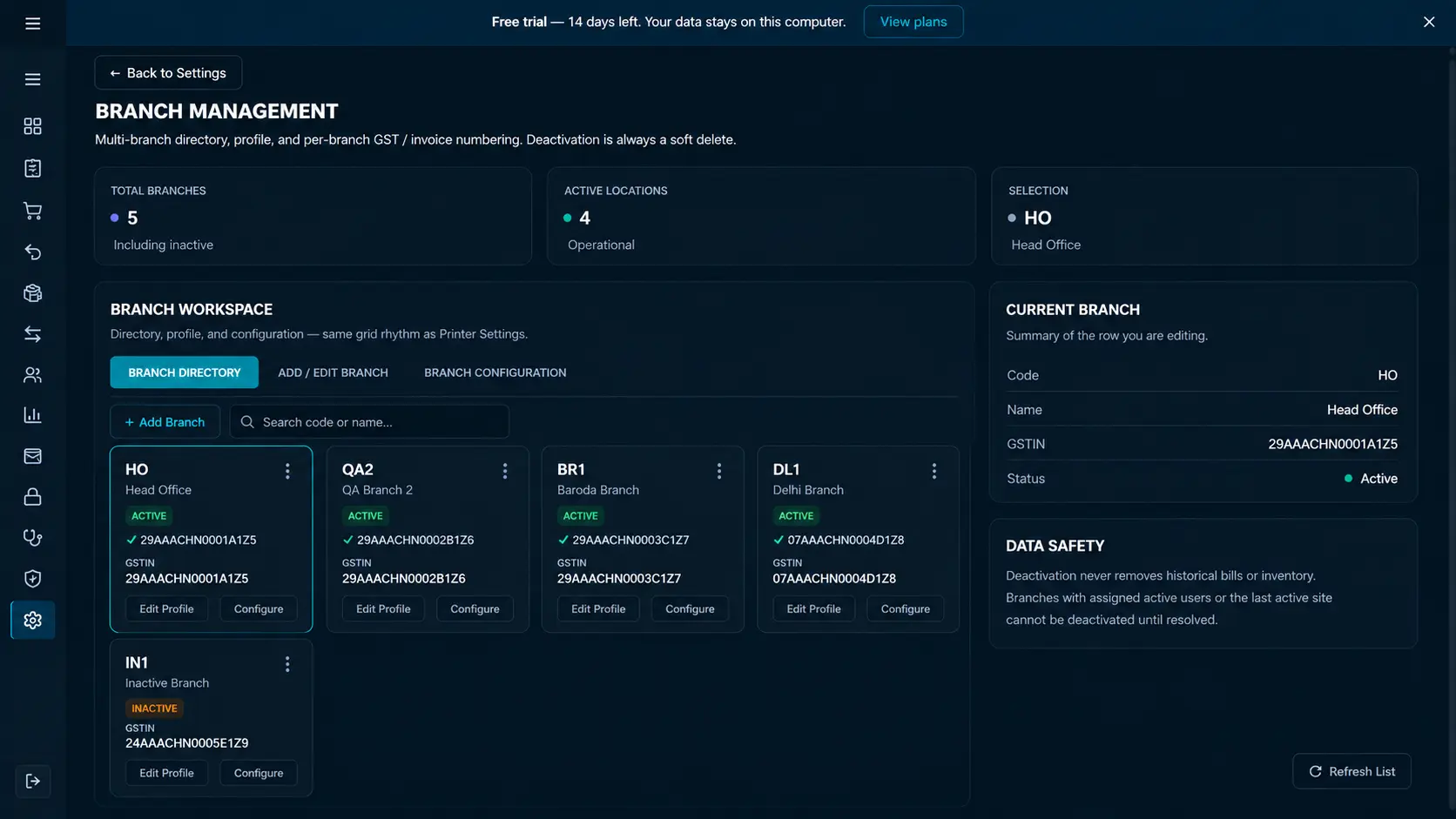
Multi-branch workflow on a Healthcare Operating System is the rollout and daily operating path where each hospital, clinic, or pharmacy branch keeps offline-capable local registers with branch and user context, replays queue, billing, inventory, and TPA events to HQ under policy, and preserves explainability for transfers, returns, and exceptions—without merging every counter into one cloud database that must answer every keystroke at billing time. Group rollouts fail when HQ buys dashboards without branch workflow adoption.
Local counter truth
Branch-scoped billing and inventory events
Queue & consult
OPD workflow stays branch-local first
Governed sync
Replay when connectivity and policy allow
HQ visibility
Exceptions, aging, stock—not blended fiction
Transfers
Inter-branch stock with accountability
Rollout waves
Pilot branch before group-wide switch
Pharmacy chains and hospital groups discover pain when every branch runs a different mental model of truth. Hyderabad bills on one POS, Mumbai on another, and headquarters receives WhatsApp photos of daybooks. Queue tokens in one clinic do not explain billing in another system's export. TPA aging is branch-blind until finance builds a spreadsheet. Near-expiry stock sits in Jaipur while Pune stockouts—because no governed transfer record exists. Offline outages at one branch become invisible to HQ until month-end. Standalone multi-store POS may sync totals but lose batch, payer, and user context finance needs to explain disputes. The problem is not missing a cloud dashboard—it is missing multi-branch as a workflow discipline on one Healthcare Operating System where AI intake, queue, consult, GST billing, offline replay, inventory, and TPA alignment share branch-scoped events. Without that discipline, expansion feels like repeated rescue missions instead of repeatable rollout.
Traditional rollouts use nightly CSV uploads, shared Tally ledgers, or franchisor templates that each branch interprets differently. Reception and queue tools are local. Billing exports land in finance without user or batch detail. Inventory transfers happen on phone calls with paper challans. TPA teams reconcile payer rows disconnected from which branch dispensed. AI Receptionist—if purchased—serves one flagship hospital while branches keep manual phones. Offline branches maintain shadow registers HQ never sees until someone drives to the store. Expansion means another bespoke migration instead of repeating a proven checklist. Owners see revenue totals but not operational exceptions that predict write-offs and compliance risk. Each branch optimizes locally; the group pays centrally for ambiguity. Training materials diverge per city because no one wrote the rollout playbook on a shared Healthcare Operating System spine.
Hayati assigns branch and user context to operational events—queue check-ins, GST bills, inventory moves, TPA flags, AI booking handoffs—not only to revenue totals. Each branch runs offline-first counters locally; governed sync replays enabled events when connectivity and policy allow. HQ reviews branch-scoped registers, stock, and exception queues instead of flattening all facilities into one meaningless ledger. Inter-branch transfers record accountability on the same spine as FEFO dispense. TPA aging filters by facility so finance chases the right pharmacy team. AI Receptionist bookings tag source branch for reception validation. Rollouts start with one pilot branch proving printers, GST formats, imports, close routine, and disconnect behavior—then repeat the checklist. Multi-branch is not only licensing many desktops; it is one Healthcare OS workflow repeated with local truth and central explainability. Conflict resolution and master refresh rules are documented for IT before wave two—not discovered during crisis.
Owners see which branch created a bill, return, transfer, or TPA exception—not only consolidated sales. Pharmacists transfer near-expiry stock with evidence instead of verbal agreements. Finance reduces month-end arguments with pharmacy when batch and payer context survived sync. Operations compare OPD queue discipline across polyclinics when events are branch-tagged. Tier-2 cities keep serving during outages while HQ visibility catches up—no manual daybook heroics every night. Single-branch operators structure masters and permissions cleanly before expansion so branch two is rollout—not reset. IT teams document conflict resolution once instead of improvising per city. Benefits assume you still define transfer policy and still staff each counter—software does not replace regional managers. Hayati targets governed visibility without forcing always-online counters that fail Indian networks. Regional finance reviews branch KPIs with the same evidence pharmacists use at dispense.
AI Receptionist routes calls to branch rules—department keywords, DIDs, and language packs per site—while bookings land on the correct branch dashboard for morning validation. Queue management stays branch-local so token fairness is not corrupted by cross-branch merges. AI Retention Agent follow-ups respect branch cadence and deduplication policy when sync returns. AI does not reallocate stock or alter branch registers silently; it reduces missed intake that branches otherwise reconcile manually. Pilot AI on one branch before group-wide activation—measure correction rate and escalation volume per facility. Central marketing promises fail when each branch's operational reality differs; governed AI respects branch context on the same spine as billing and inventory. Regional managers should sign off branch scripts before HQ enables group-wide automation.
Multi-branch governance wraps every major workflow on Hayati AI Nexus: AI Receptionist intake tagged by branch; queue management and Doctor Dashboard OPD paths local-first; GST billing and offline billing registers with branch-scoped tax and replay; pharmacy inventory with FEFO and transfers; TPA billing alignment with facility-filtered aging; governed sync and HQ dashboards on platform services you enable. This page describes roll-up and rollout—not a standalone chain dashboard product. Walkthroughs need your branch map, one transfer, one return, one TPA case, and one deliberate disconnect per pilot site. Licensing and sync policy are scoped during enterprise evaluation—not hidden behind generic per-store pricing tables on this marketing site.
Retail multi-store POS excels at checkout volume and simple SKUs. Hayati fits hospital and pharmacy groups needing queue, consult, batch inventory, TPA, GST discipline, and offline continuity per branch—not only SKU velocity. Cloud HMS may centralize data but weakens ward and Tier-2 offline counters. Marg-style ERP may multi-branch trade counters without OPD queue or AI intake. Comparison is operational explainability per branch—not the most stores on one login screen. If HQ only needs daily sales totals and never audits batch or payer context, lighter tools may suffice until governance matures. Serious groups bring region managers to walkthroughs because rollout success is operational adoption—not only software installation dates.
Register each facility, GST premise, user roles, and sync policy with operations and finance during onboarding.
Prove queue, billing, inventory, printers, offline replay, and close routine before group-wide dependency.
Each branch runs AI intake, queue, consult, GST or offline billing, and FEFO dispense with branch context on every event.
Enabled events replay to HQ with duplicate-safe retries—conflict rules documented for IT review.
Finance and operations filter TPA aging, returns, and stock anomalies by facility—not one blended total.
Move batch stock with accountability tied to inventory and billing spine—not phone-call folklore.
Repeat pilot checklist per branch with import validation and staff sign-off.
Registers, batch trails, and user context support review—Hayati strengthens evidence; policy remains yours.
No. It is branch-scoped workflow on a Healthcare Operating System—local counters, queue, billing, inventory, and TPA events with governed roll-up.
No. Local-first billing and queue continue offline; sync replays enabled events when connectivity and policy allow.
Each branch maintains GST-shaped registers locally; offline replay preserves branch context so HQ does not merge counters blindly.
Yes where deployed—finance reviews facility-scoped queues instead of one ambiguous group ledger.
Transfers record batch movement with accountability on the same spine as FEFO dispense—validate on walkthrough with real SKUs.
Call routing and booking rules can be branch-specific; bookings tag source for reception validation on the correct dashboard.
When expansion is likely—clean masters, permissions, and workflow discipline make branch two a rollout instead of a reset.
Branch map, pilot plan, one transfer, one return, one TPA example, and one disconnect test—not only HQ charts.
Explore Hayati by workflow
GST billing, FEFO inventory, and branch operations for pharmacy counters.
Keep billing locally when internet drops, then sync when the line returns.
Batch, expiry, and stock visibility built into the counter workflow.
Hospital pharmacy billing, branch context, and payer-aligned operations.
Keep pharmacy billing and reconciliation data easier to review.
Governed front-desk support without clinical overclaims.
A factual comparison for pharmacies planning a legacy ERP switch.
Discovery, trial import, validation, and phased branch rollout.
Published Starter and Growth plans, with Enterprise scoped separately.
OPD, IPD, pharmacy, lab, and radiology on one operational spine.
Treatment plans, OPG integration, and patient billing for dental practices.
Recurring sessions, patient scheduling, and compliance management.
All features: AI Receptionist · AI Retention Agent · Patient Queue Display · Doctor Dashboard · TPA billing · Multi-branch · Pharmacy inventory · GST billing · Offline billing · Queue management
We map branches, sync policy, pilot checklist, and licensing before group-wide commitment—on your facilities and payer mix, not a generic chain slide deck. Bring region managers and finance to the first session.